ASPL User Guide v 1.00
© 2025 Bassem W. Jamaleddine
Finding Files with Different Names but with Identical Contents
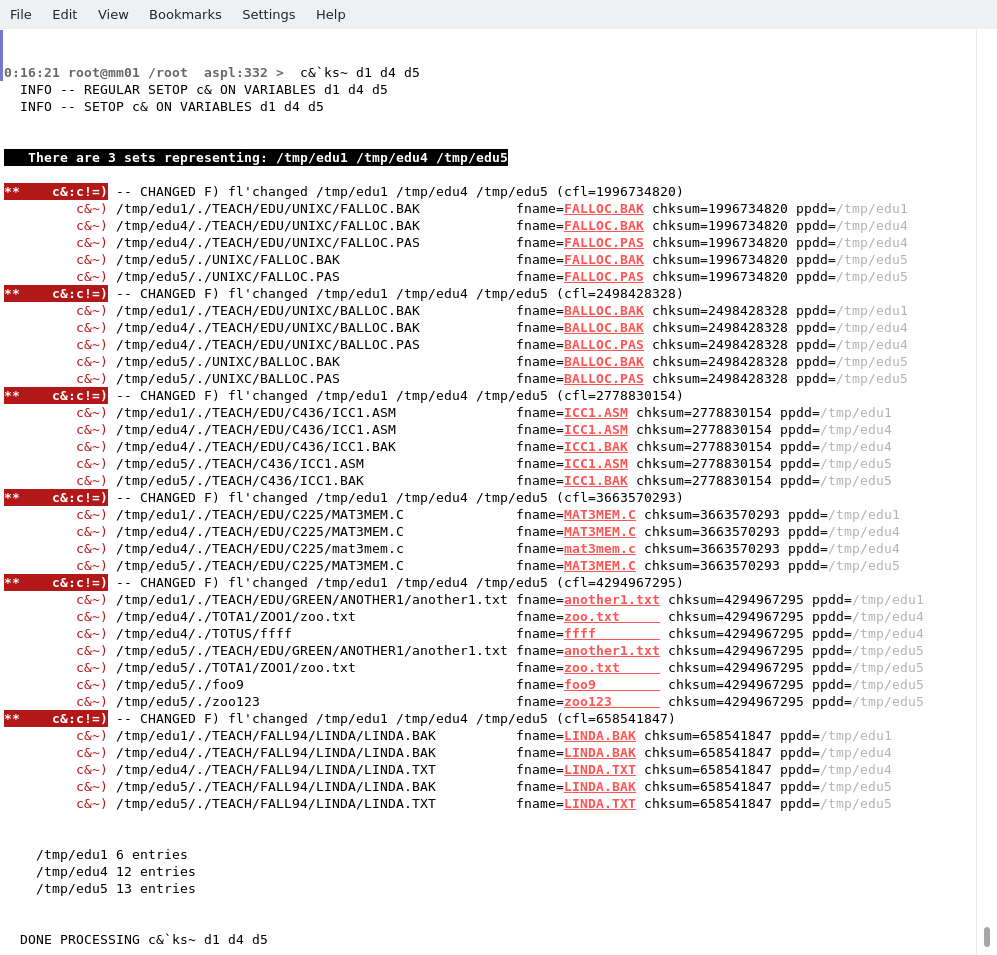
The operator c& can find the intersection of elements that have the same checksum. By setting the ks vector to include the attribute fname, then ticking c&`ks~, it is possible to find these files that have the same checksums but with different names.
Finding Files with Different Names but with Identical ContentsIn this example, the three set variables d1, d4, and d5, represent the groups of files in three directories /tmp/edu1, /tmp/edu4, and /tmp/edu5 respectively. Use the c& to find the files that have a common checksum in a group of directories. Set ks vector to include the fname attribute, then tick c& with`ks~ to find these files in the three directories that have the similar contents, but have different names.
Finding Files with Different Names but with Identical Contents# aspl NIXDIR
aspl>
ks fname chksum ppdd
make sure ks vector has the fname attribute
To find these files with same contents but different names in the set variables d1 d4 d5
aspl>
c&`ks~ d1 d4 d5
(find these files with same contents but different names)
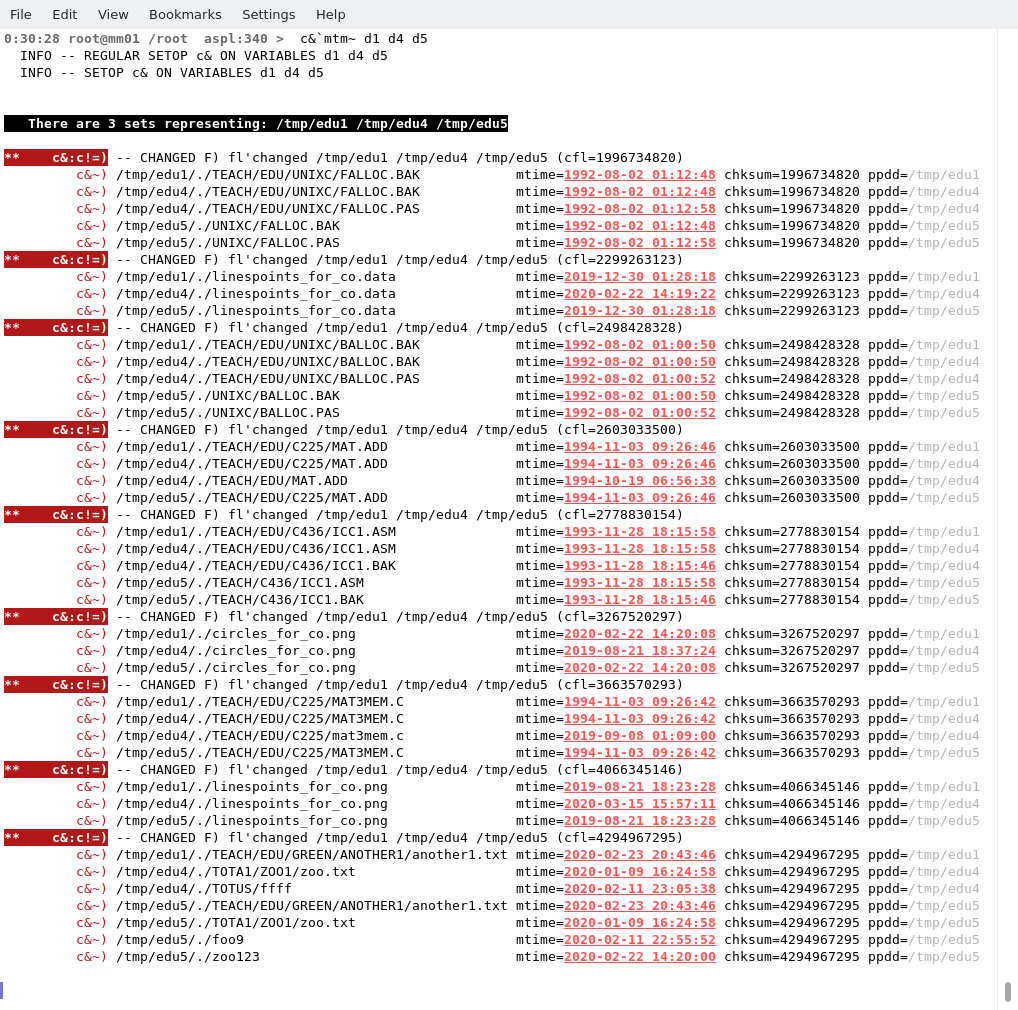
To find these files with same contents but have different mtime
aspl>
ks mtime chksum ppdd
make sure ks vector has the fname attribute
aspl>
c&`mtm~ d1 d4 d5
(find these files with same contents but have different mtime)
To find these files with same contents but have different entropy (it is unlikely to find any!)
aspl>
c&`h~ d1 d4 d5