ASPL User Guide v 1.00
© 2025 Bassem W. Jamaleddine
19. 2Differential Group Operations on the Variables Representing a Process
Differential Operations on Random Group Process
ELEMENTS-GROUPING-CLASS: BITGROUP
Sample workspace: RANDGROUPPROCESS
GG-function: ggrandbitgroupS()
Getting a random group process and assigning to P
P = ggrandbitgroupS( .. ) where P is a set variable
Interrogating the set variable representing the process
?5,1 P interrogate P five times with one second delay
Show changes in the differential group variable P
g@, P
Show changes in P where attributes have changed
g@,`ks~ P
Show changes in P where attributes are the same
g@,`ks= P
Note that ks is settable, issue help ks or ks to see what is being set to
Applying ASPL differential group operators on process represented by a random bit group
Here we demonstrate the usage of the differential group operators on a random process represented by a certain variable P. The variable P is said to be a differential group variable since it contains its temporal changes. The GG-function ggrandbitgroupS() creates a random group in the domain of the egroupingclass BITGROUP. The function takes various parameters to let the user specify the number of random subgroups, random subsubgroups, and the random elements to be contained in them.
Differential Group Operations on the Variables Representing a ProcessWe create a random group process and assign it to the differential group variable P. To get the changes in the process associated with P we apply various differential group operations on P.
Differential Group Operations on the Variables Representing a Process
We start ASPL by loading the sample workspace RANDGROUPPROCESS whose element grouping class is BITGROUP.
# aspl RANDGROUPPROCESS
(start ASPL loading the sample workspace RANDGROUPPROCESS)
① aspl>
P = ggrandbitgroupS(gstart,1,gcount,1,dcount,3,dmin,4,dmax,7,scount,4,smin,5,smax,8,sfcount,4,sfmin,2,sfmax,6, sscount,3,ssmin,5,ssmax,7,ssfco unt,4,ssfmin,2,ssfmax,9, fcount,4,fmin,2,fmax,6,mix,1)
get in P a random group process
② aspl>
sleep 1③ aspl>
?5,1 P
interrogate P in a loop five times with one second delay
④ aspl>
dm 5
set display mode to 5
⑤ aspl>
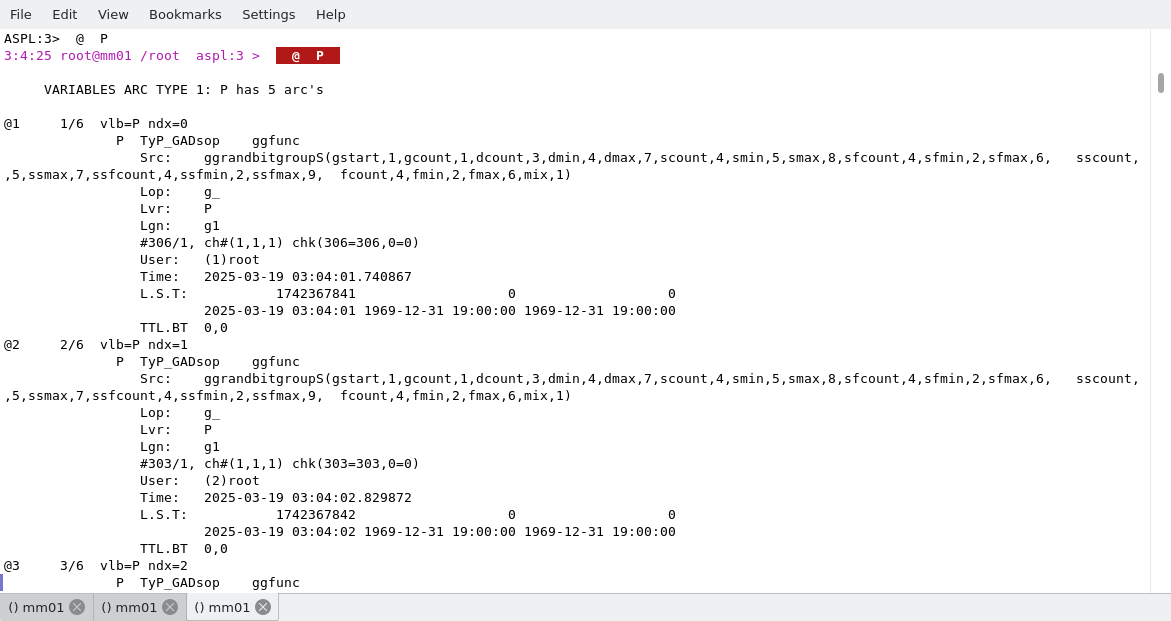
@ P
print the differential group variable P showing all its instances
⑥ aspl>
g@, P
apply the group differential operator on P
⑦ aspl>
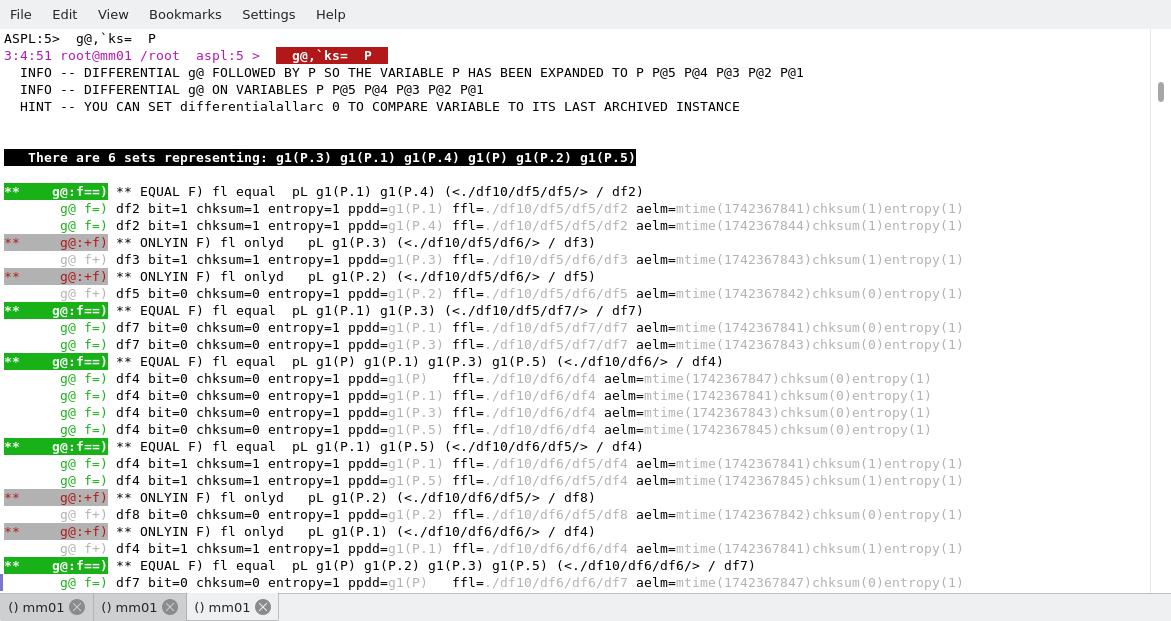
g@,`ks= P
apply the group differential operator (such that ks is the same) on P
⑧ aspl>
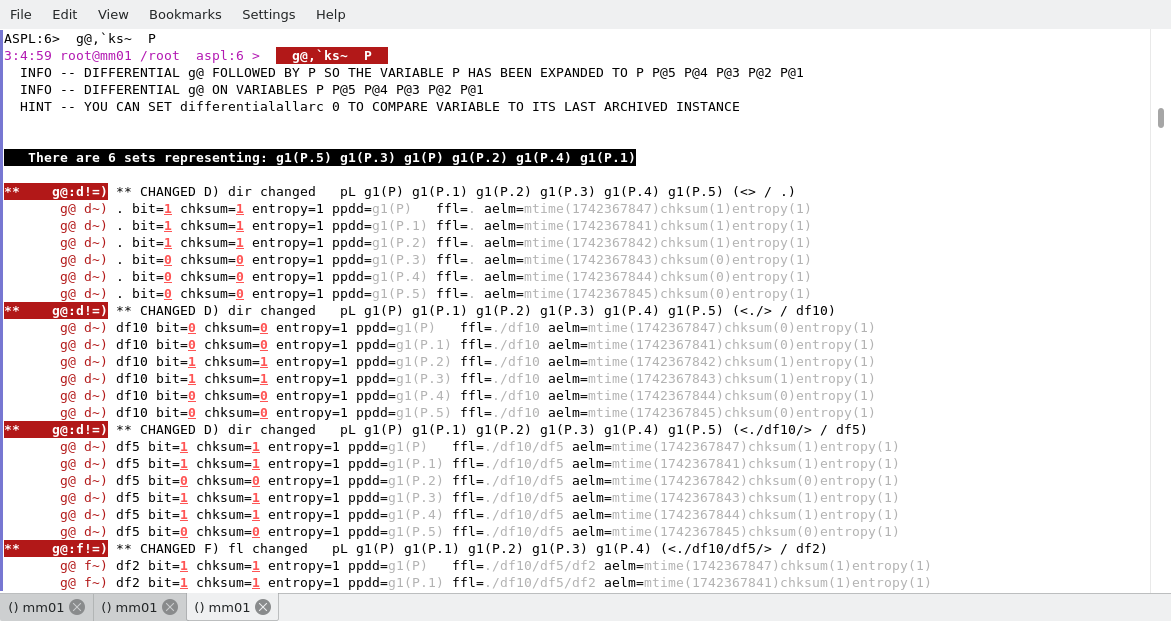
g@,`ks~ P
apply the group differential operator (such that ks is different) on P
⑨ aspl>
f@, P
apply the elements differential operator on P
⑩ aspl>
f@,`ks= P
apply the elements differential operator (such that ks is the same) on P
⑪ aspl>
f@,`ks~ P
apply the elements differential operator (such that ks is different) on P
⑫ aspl>
d@, P
apply the subgroup differential operator on P
⑬ aspl>
d@,`ks= P
apply the subgroups differential operator (such that ks is the same) on P
⑭ aspl>
d@,`ks~ P
apply the subgroups differential operator (such that ks is different) on P
⑮ aspl>
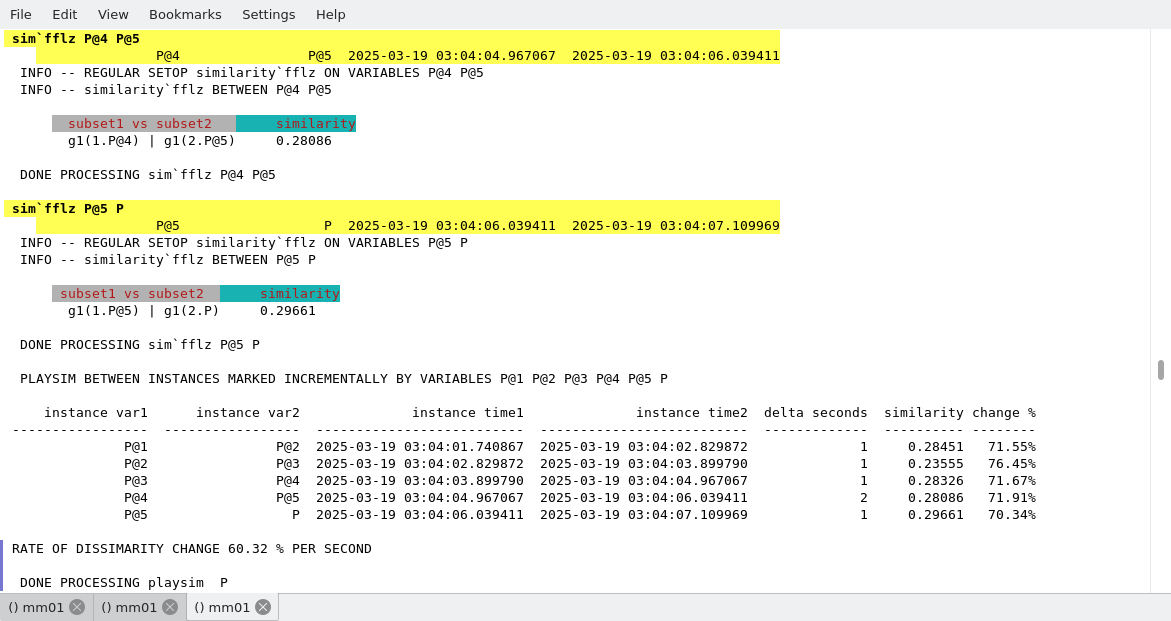
playsim P
show the rate of change of dissimilarity in the process P
⑯ aspl>
intermittentarc 1
set intermittence on the archived differential variable to 1
⑰ aspl>
playchanges P
show the temporal rate of change in the process P
The following display shows the operations on the random process P in the sample workspace RANDGROUPPROCESS.
The following figure shows the differential group variable P
The following figure shows the differential group operator g@,`ks= as applied on the differential group variable P
The following figure shows the differential group operator g@,`ks~ as applied on the differential group variable P
The following figure shows the rate of changes in the process P
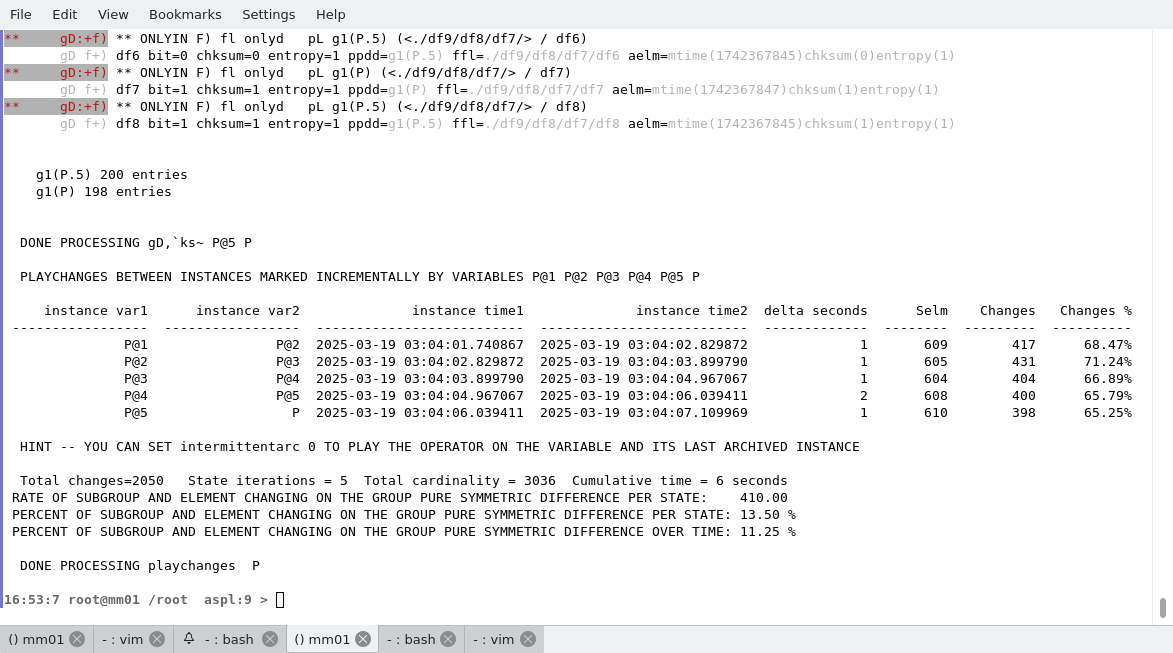
The following figure shows the rate of changes (of dissimilarity) in the process P