Chapter 19
Differential Group Operations
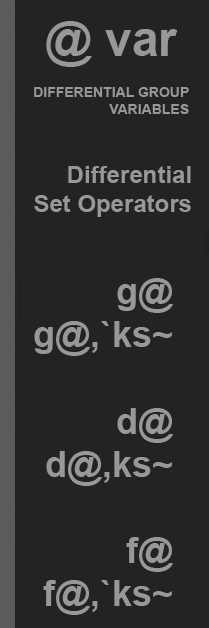
The three set operators: g@, f@, and d@, are called differential operators because they do their grouping operations on a set variable and all its temporal changes. Since changes in an ASPL set variable are held within the variable along the time of change, therefore such a variable is also called a differential group variable. You can use the following set operators: g@, f@, and d@, to perform set operations on differential group variables. These three set operators are called differential operators because they do their grouping operations on a set variable and all its temporal changes. A set variale on which a differential operator can be performed is called a differential group variable. For instance, g@ x displays the difference in the group pointed to by the set variable x and its last archived instance. The g@ x won't capture the elements whose attributes may have changed. However, one can use the tick predicate to specify the predicate "such that where the ks-vector attributes are different" to capture the differences in the changing attributes: g@,`ks~ x. Here the comma following the differential set operator is a labination operator, and the tick predicate `ks~ is catenated for the condition aforementioned. The operator @ x list the archives of the differential group variable x. By interrogating a set variable, ASPL sources the variable: if any change in the data is detected, then the variable is archived and reassigned with the sourced data. Therefore, ASPL set variables can be viewed as differential variables, and you can use the command playsim to play the similarity on such a set variable. The command causes an iteration aggregating the similarity between the historical archived data over time, and since ASPL variables maintain the time of their creation, then the command aggregates and calculates the Rate of Change in Dissimilarity of the Process represented by the set variable.